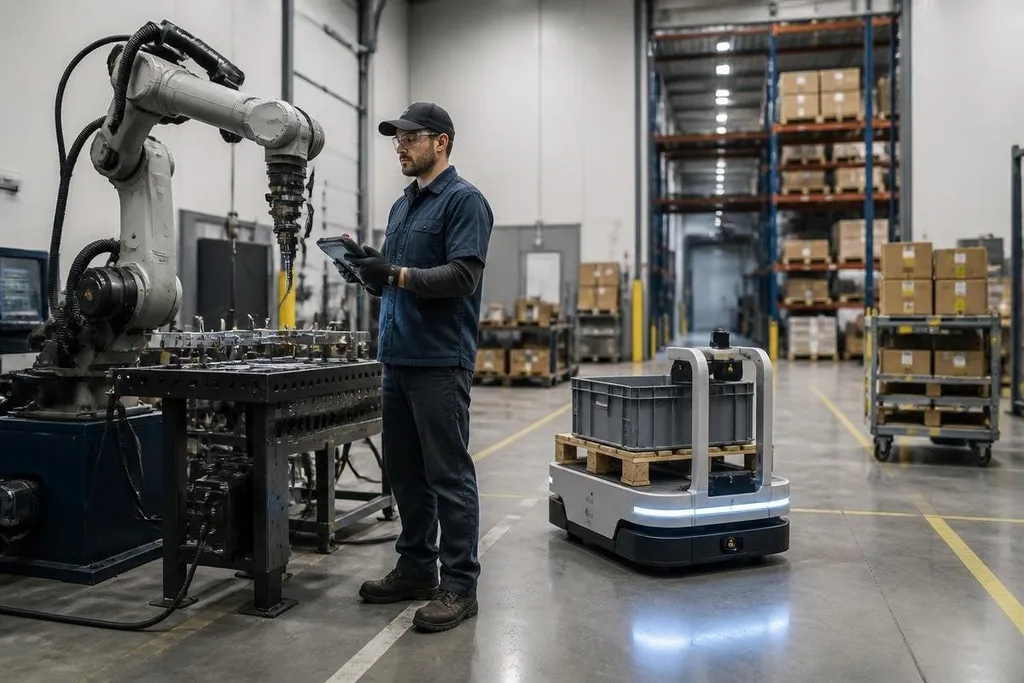
A robot arm can repeat a weld for hours, while a mobile robot can carry parts across a factory floor. The likely change for blue-collar workers is a shift in daily tasks, with people still setting up, checking, repairing, and managing the work.
- Robots suit repeat jobs with fixed steps and clear safety limits.
- Workers still handle faults, changes, quality checks, and customer needs.
- The cost case depends on the task, the site, and the support team.
The task matters more than the job title
A job title can hide many different tasks. A warehouse worker may pick items, walk between shelves, scan labels, move a cart, and deal with damaged stock during one shift.
The repeated movement may go to automation while the worker handles exceptions. That split can reduce walking and lifting, but it also changes what the worker must know. They may need to read a fault message, clear a blocked route, or check why a camera missed a label.
The same pattern applies in factories. Fixed equipment can load a machine, place parts, or apply sealant when the work area stays fixed. A technician still has to set the arm’s path, change the gripper for a new part, and check the result after a fault.
This makes the first question practical: which task causes the most strain, delay, or repeated errors? Start there. A full job rarely suits automation in one piece.
Robots work best when the steps stay close to the same each time. Sensors and software can guide the machine, but the site still needs clear rules for people working nearby.
A fixed robot arm can handle tasks such as moving parts between two set points. Mobile equipment can carry bins along marked routes. A vision system, which uses cameras and software to inspect an item, can check shape, position, or surface damage.
These systems can change the workday in several ways:
- Less lifting means fewer manual moves for a worker who handles heavy bins.
- Fewer long walks leave more time for stock checks and fault reports.
- Repeatable placement gives a technician a clear result to inspect.
- Machine records show when a stop, jam, or failed scan happened.
The value depends on what happens around the robot. If a worker must wait beside the machine during every cycle, the site may shift effort rather than cut it. If a robot stops when a box is out of place, someone needs the time and training to fix that interruption.
New work comes with new risks
Automation can remove strain from a task, but it can also raise the need for technical judgment. A worker may handle several machines, check sensor readings, and decide when a process should stop instead of carrying parts between workstations.
That change needs training before the robot reaches the floor. A short course on safe isolation, robot programming, or basic sensor checks may matter more than the machine’s maximum speed.
Safety also depends on the whole work area. A robot arm, conveyor, camera, and human walkway form one system. Guards, emergency stops, warning lights, and access rules must work together. The robot’s own safety feature cannot fix a poor layout or unclear procedure.
Job numbers are harder to predict without details about the site. A company may need fewer people for one repeated task and more technicians for maintenance, controls, or quality work.
Pay, training time, and access to new roles need numbers too. Reporting on workplace robots can tie those claims to named companies, tasks, and sites. The next question is what remains unproven.
What remains unproven
A demonstration can show that a robot completes one task. It does not show how the system handles dust, changing parts, missed scans, software faults, or a full shift with people nearby.
Cost also extends beyond the robot. You may need new power lines, guards, software, floor changes, spare parts, and staff training. A cheap arm can become an expensive project if the work changes often or the site lacks maintenance support.
For a plant supervisor, the useful test is a small one. Measure the task before buying anything, then compare the robot’s full running cost with the current process. Record stops and manual fixes, not only the successful cycles shown in a sales demo.
I’d keep people close to the work until the robot has shown stable results under normal site conditions.
A practical buying checklist
Use these questions before you approve a pilot:
- Name the task: can you describe its steps, input parts, and finished result?
- Count the variation: how often do size, shape, route, or order change?
- Check the handoff: who loads the robot, clears faults, and checks quality?
- Price the whole job: include guards, software, training, power, service, and downtime.
- Set a trial measure: record cycle time, stops, errors, and manual work across normal shifts.
- Plan the worker role: decide what training and authority people receive before launch.
The next useful robot project may be small: one lifting task, one inspection point, or one route between machines. If that trial cuts strain without hiding new work behind a screen, the site has a sound reason to add another machine.